
The Advanced Lucid Dream Induction Technique (ALDIT)
copyright 2026 G. Scott Sparrow, EdD, www.dreamstarinstitute.com
This morning, I awoke at 5:30 and meditated for 45 minutes before going back to bed. Within a couple of minutes, I was hearing and feeling a familiar vibration that comes, at first, in waves, and then flattens out as it intensifies. I “rolled” over and left my body, traveling into a featureless void before emerging into a vivid, entirely realistic world where I interacted with a variety of people, some of whom recognized me from other experiences. An hour later, I decided to return to my bed after almost an hour of being away.
This happens just about every time I try, which is about once a week. I don’t think I’m that different from you, so I am going to share what works for me in case you want to try it. It’s called the Advanced Lucid Dream Induction Technique, and it’s a synthesis of three tools that I have discovered over the past 50 years.
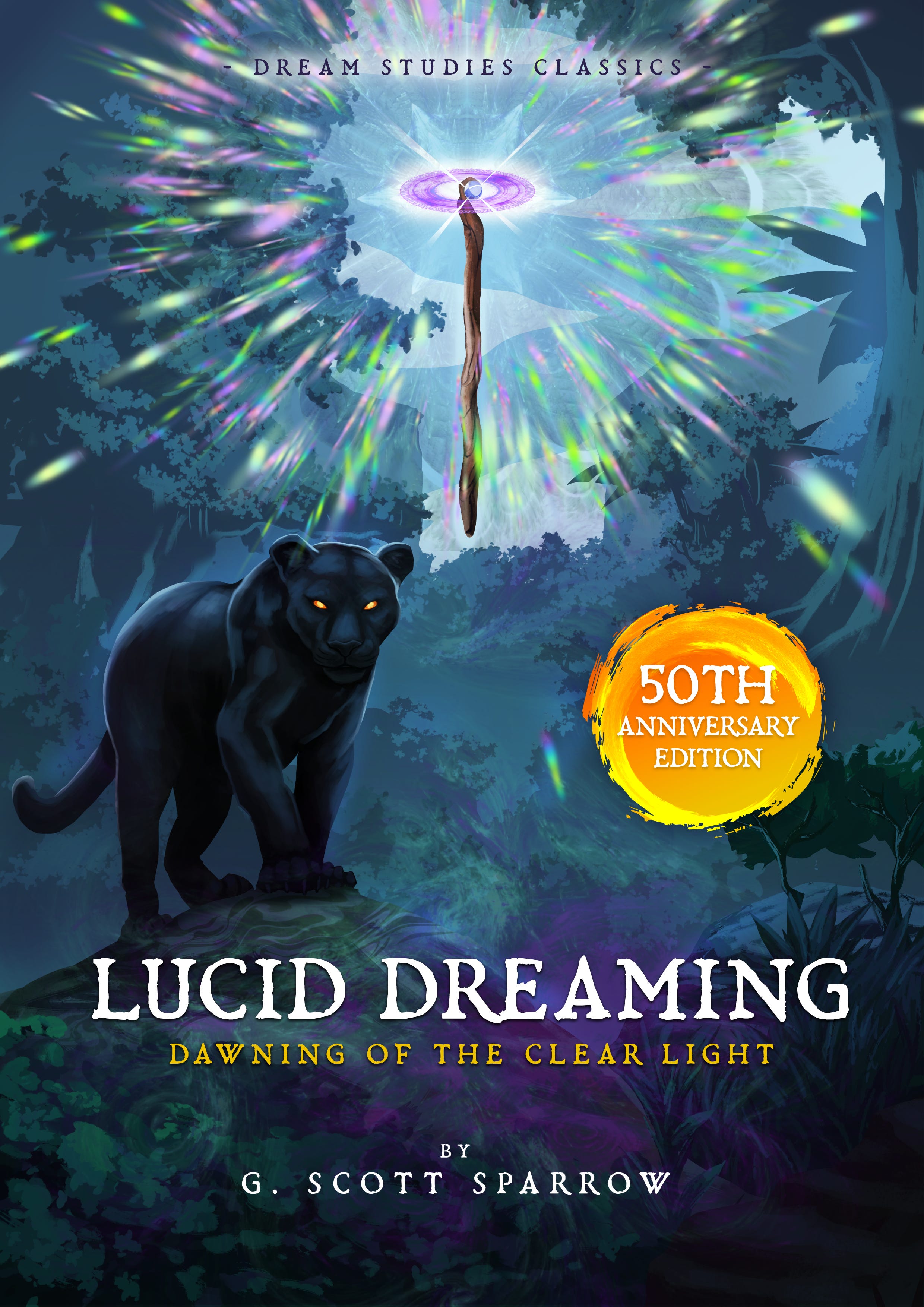
In 1974, I was 23 when I began writing my thesis on lucid dreaming, which turned into Lucid Dreaming: Dawning of the Clear Light (1976; 2026). At that time, I believed that meditation was the most effective catalyst of lucid dreaming. Specifically, I would awaken at 2-5:00 am and meditate for 30-60 minutes before going back to bed. I was amazed by the dreams that ensued—lucid dreams (that formed the basis for my book), dreams of light (recounted in a recent paper co-authored by Ryan Hurd) and dreams of spiritual beings who anointed me with their presence (that inspired two books published in the 1990s).

Meditation was the first feature of an integrated practice that evolved over the next 50 years. A few years after the publication of Lucid Dreaming, I did a research dissertation at the College of William and Mary titled, “An Exploration into the Induction of Greater Awareness and Lucidity in Nocturnal Dream Reports” (1983). In a study involving 147 participants, I tested whether “dream reliving,” or the experience of reliving a past distressing dream in fantasy as if one is lucid would result in higher levels of self-reflectiveness, interaction, role changes, and constructive action in subsequent dreams. Similar to “Imagery Rehearsal Therapy,” pioneered by Barry Krakow and his colleagues, Dream Reliving effectively creates a new emotional experience through active engagement rather than merely rewriting a new ending.
So at that juncture, I had embraced two powerful tools for inducing greater awareness in dreaming: meditation and dream reliving. And, for about 25 years, I used them in my own spiritual practice, and began introducing them to others through articles and research studies. But even then, lucid dreaming continued to be elusive for most people.
Around 2008, I discovered a third tool for inducing lucid dreaming—the cholinesterase inhibitor galantamine, an extract of the snow drop lily. Available without a prescription in the US, it is known as a treatment for cognitive decline, but Stephen LaBerge discovered its usefulness as a lucid dream induction supplement after finding that his mother reported vivid dreams after taking a similar cholinesterase inhibitor (which makes the neurotransmitter acetylcholine more available). After I started experimenting with it, my research team conducted the first-ever peer-reviewed study on its effectiveness in stimulating lucidity (Sparrow, Hurd, Carlson and Molina, 2018). LaBerge and his team followed with a similarly positive research study.
In our 2018 study, we combined galantamine with meditation and dream reliving to see if an integrated approach would work better than the individual components. While galantamine was the only statistically significant contributor to the outcomes—increasing the frequency of lucid dreams by 250%—I have been convinced that the integrated methodology, which I’ve termed the Advanced Lucid Dream Induction Technique—covers all of the psychological, physiological and spiritual requirements for achieving regular lucid dreaming. In our study, our participants used the integrated protocol only briefly, not giving it much of a chance to show its impact. But from using it myself for about 20 years, I have discovered that the method “sets up” a state of mind that combines the non-reactive witnessing fostered by meditation, a sense of increased agency fostered by dream reliving, and increased neurological processing that supports self-reflectiveness and cognitive resilience.
Here’s the steps of the ALDIT:
Step One: Preliminary Preparation
- Ideally, no alcohol the night before, or at least a minimal amount
- Mood positive, no immediate emotional conflict or mental preoccupation
- At least four hours of sleep before awakening (Step Two)
- Two to three hours of sleep afterward
- Awaken and get out of bed.
- Optional: Ingest 4-8 mg of galantamine. You can obtain a supply without prescription through Amazon vendors and other online sources. If you use galantamine, make sure you eat a snack and drink plenty of water or fruit juice after you ingest it. Please check with your physician before you use it.
- Meditate for 30-45 minutes. Don’t trust yourself to meditate lying down. :-)
- Use whatever method you choose.
- Select a dream in which you wish you would have responded differently.
- Relive the dream in your imagination.
- Respond to the situations that arise in your imagined dream as if you are lucid, and fully aware that you are dreaming.
- Focus on changing your response according to what feels appropriate for you and see what naturally happens as a result of your new responses. Your responses may not represent an ultimate solution (e.g. forgiveness), but may represent an important developmental step toward an ultimate solution (e.g. fighting back against an aggressor as a way to express your autonomy and freedom from control).
- After reliving your dream, make mental note of the new “dream” so you can jot it down later. But for now, go back to bed.
- As you lay in bed, affirm to yourself, “I wish to become more aware in my dreams, and respond in appropriate ways to whatever I encounter.”
- Slowly count backward from 100 to 1.
- You may get drowsy and lose your place, which is good.
- You may return from a brief loss of consciousness and feel/hear a vibration in your head that comes and goes, as if a valve is opening and closing. This is very good! The waves are generated by the reticular activating system, and precede the ability to separate consciously from the physical body (at least experientially)
- If the energy arises, meditate on the energy, and it will probably get more intense. You will be able to roll over and out of your body if the energy is present. This is called a Wake-Initiated Lucid Dream (WILD).
- If you fall asleep without hearing the energy, you have a very good chance of becoming lucid in your dream. This is called a Dream-Induced Lucid Dream (DILD).
- Even if you have a vivid dream, lucid or otherwise, you will quickly forget it just like any other dream. If you want to remember it in full detail, have your phone or a digital recorder next to your bed, and record your recollection as soon as you awaken.
Sample post-ALDIT LD/OOBE:
GSS Dream session 7/2/25
I woke up at 3:30, and meditated for about 40 minutes, after taking 8 mg galantamine. I was in a pretty good mood, and expected good things. I did the countdown and got down to about 75 and the energy started. So I started flying into space, and found myself very quickly in enclosures where the walls were very imposing, and so I moved toward an opening and expected to experience the openings closing up on me which they did. Everything started to move in the direction of preventing me from gaining access to the open sky, which was very frustrating. Then I ran past some men and noticed that everything was shutting down on me and so I just gave up. I stopped and began to relate to them and ask questions and get to know them. As I did, the reaction of the dream stopped and everything opened and I could do what I wanted to do. A lesson here about not having a selfish agenda, but instead connecting with people and opportunities at hand.
The lucid dream continued for over an hour, and I went through several different scenarios with people who embraced me and cared and offered their hospitality. At one point, I was sitting on the ground in a circle of people petting a dog that was affectionate, and a man with a guitar was singing, and it was beautiful. So much happened, and as usual, I’ve forgotten most of it. But toward the end of the dream or out-of-body experience, as it seemed to be, I was remarking that the clarity of the experience was just unbelievably clear and stable, and that people would be shocked by how real these experiences are. (I did one set of eye movement signaling in the middle of the experience for the Enchanted Wave EEG headset.)
I flew on and came to a wilderness area. I seemed to be in a Southwest-type setting with indigenous people nearby. I walked along and looked down on the ground, and saw to my amazement, a beautiful crystal green sphere like a marble on the ground. It was a beautiful midgreen and clear, as if it was lit from within. I reached down and wanted to see if it was solid in the experience, and it seemed to be quite durable. Then an old man came up, and he and a younger man told me about how they fashioned these gemstones.
Then I said goodbye, and set about to return.
I flew up into the sky and turned over and allowed myself to be on my back flying homeward. I was not able to look forward, but only able to look behind me. As I flew quite rapidly, I passed over people, and was able to look at them in my rearview mirror, so to speak. One man was reading to his child, and there were several men gathered together, and they looked up and saw me as I passed. Music started playing, which was beautiful. It was Barbra Streisand, singing the song “Smile.” I woke finally, or came back to my body to the sound of her singing. I felt so fulfilled and so restored by the experience. Later that morning, I looked up the song and found that Streisand had actually sung “Smile” and that it was on YouTube! So I shared it with Julie (my wife) later in the morning, and we enjoyed the song. It reminded me of how precious the experience had been and what a gift to have the music accompany me back into my life.
So you see what the ALDIT can do? These experiences are commonplace for me, and I believe that they are much more available than people realize.